

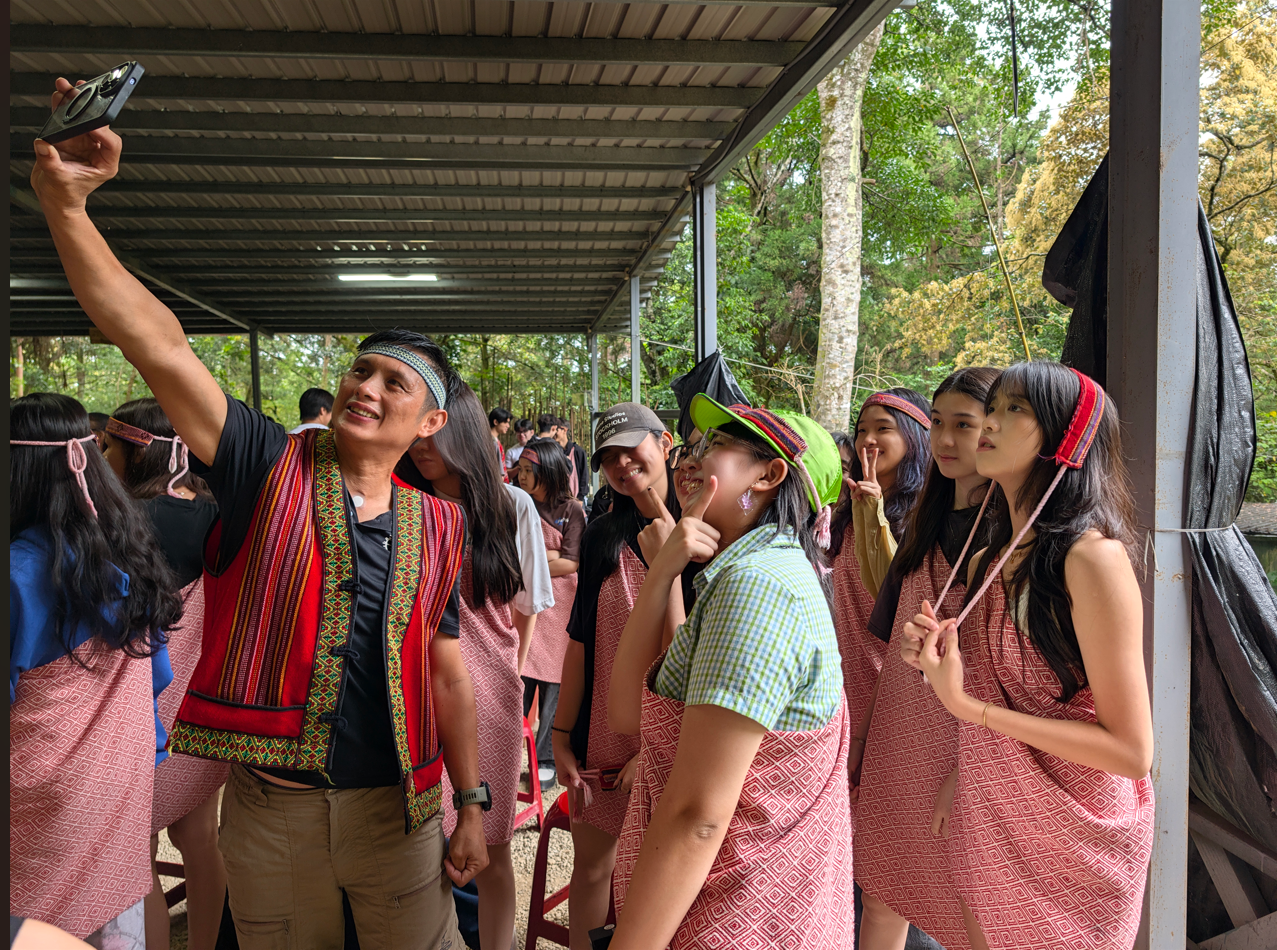
Last Friday, VIS students and teachers headed to Gesuw Campground in Wulai, New Taipei. It is a place rooted in the traditional life of the Indigenous Atayal people.
"Gesu" means "crepe myrtle" in the Atayal language, and is also the Atayal name of the host Chen Chin-fa, who warmly welcomed students and introduced the tribal mentors. Students were guided by mentors, dressed in traditional Atayal clothing, learned Atayal greetings (lokah), everyday expressions, and cultural norms known as "gaga".
Cultural immersion followed as students tried their hand at preparing bamboo rice (mami btakan) and roasting wild boar. From chopping bamboo to stuffing and grilling, they crafted the traditional dish from scratch.
While waiting for the rice to cook, students split into groups to rotate through two main workshops: archery and trap-setting. One group practiced shooting arrows (mlung bhuniq), while the other learned how to set animal traps (t rusa’ and rangay). Bows and arrows are crucial for defending against large wild animals like boars or bears, while traps showcased Indigenous knowledge of the land. Each species, whether a bamboo partridge, mountain rat, or boar, required unique techniques and tools made entirely from natural materials.
上週五,VIS 高中部的師生們一早從臺北出發,前往位於新北烏來的泰雅族部落「給樹營地」。「給樹」是泰雅族語「九芎」的意思,也正是營地主人,即原住民文化推廣者陳金發老師的泰雅族名 Gesu。他熱情迎接我們的到來,並介紹了部落的導師們。學生們在導師們的帶領下,穿上泰雅傳統服飾、學習泰雅族的打招呼方式(lokah)、日常族語用語與傳統規範(gaga)。
接著,學生們分組製作竹筒飯(mami btakan)製作與烤山豬體驗。學生們親自砍竹、裝飯、炙烤,從頭到尾手作傳統料理,過程動手也動腦。無論是選材、切工還是火候掌握,都講究與自然環境的協調與感應。這是一堂原住民智慧的實踐課。
在等待炊飯的時,學生們分組進行了狩獵活動。一組學生體驗弓箭射擊(mlung bhuniq),另一組則學習設置陷阱(t rusa' 與 rangay)。弓箭是面對山豬、熊等大型野獸時的保命武器,而陷阱則展現出原住民依山傍水、因地制宜的智慧:不同動物如山老鼠、竹雞或山豬,都有各自設計精巧的捕捉方式,材料更完全取自自然,充分展現泰雅文化中「敬山、順山」的精神。